The Adventist Theological Society and Italian Adventist University will host a Symposium on the Trinity to be held at IAU Villa Aurora, Florence, Italy, on June 19-22, 2019.
This Seventh-day Adventist statement of belief in the Trinity is simple, not filled with explanations of how God can be three in one. Yet, it is complex in that it clearly declares both the oneness and the threeness of God. The history of the doctrine is also complex, both in Christianity at large and within Adventism. Currently in Adventism, there are a number of challenges to the idea of conceptualizing God as a Trinity so that continued study is necessary. Some want a biblical prooftext to support a doctrine, and will take a single idea about God from Scripture to represent the whole conception of God. The complexity of all that is revealed by God about God in Scripture does not lend itself to a prooftext approach to understanding God.
This symposium is intended to clarify from Scripture the fulness of the revelation about God, from history the complexity of human attempts to understand God, and from theology the attempts to express the fulness of the revelation. As such, papers will be considered which add to the understanding of the scriptural revelation on the Trinity, the historical attempts to understand the nature of God in both Adventist history and in the history of Christianity in general, and the theological attempts to express the truth about God.
Speakers include Greg Howell, Denis Kaiser, Jiri Moskala, John Peckham, Trevor O’Reggio, John W. Reeve, Teresa Reeve, Matthew Tinkham, Ekkehardt Mueller, Alberto Timm.
The cost to attend the Symposium is 220 € and is all inclusive: full board in a double room at the IAU Campus, from Wednesday June 19 in the afternoon to Sunday June 23 breakfast, and one tour.
For reservation and payment information, contact centro@casaurora.it ; Subject: ATS-IAU Symposium.
Deadline for Reservation: FRIDAY, MAY 24, 2019.

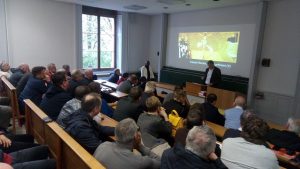
 The paper presentations would then follow one another to enrich the topic. Miguel Guttierrez (Villa Aurora, Italy) discussed the ‘prophet as a model of spiritual leader;‘ Oldřich Svoboda (Sazava, Czech Republic) explored the New Testament vocabulary of ecclesial leadership; Ivan Milanov (Newbold, England) compared ‘prophetic and cultic leadership;’ while Nestor Petruk (Sagunto, Spain), addressed a missiological dimension. Richard Lehmann (Collonges, France) approached the issue of the ministry from the perspective of the shepherd, sharing lessons from his long experience. As well as Reinder Bruinsma, who explored the question of ‘authority and conscience’ in relation to the freedom of the pastor. Alexander Schulze (Friedensau, Germany) considered the ministry in relation to the challenge of youth and its integration into the Church; a reflection usefully completed by Bjørn Ottesen (Newbold, England) on the issue of young pastors and the question of authority from participation and influence. Daniel Olariu (Cernica, Romania) focused on the happiness of ministers. Rudy Van Moere (Belgium) addressed the question of the ’pastor’s dilemma in a postmodern society,’ while Gabriel Monet (Collonges, France) concluded by showing the relevance of an evolution in the conception of the ministry in a changing world.
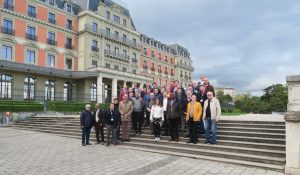
 In addition to these stimulating conferences, an afternoon at the Palais Wilson in Geneva, home of the Office of the High Commissioner for Human Rights, provided an opportunity to understand how the working commissions of this important United Nations body function, but above all to be sensitive to the “Faith for Rights” project, which seeks to encourage faith actors to be a a driving force for human rights.
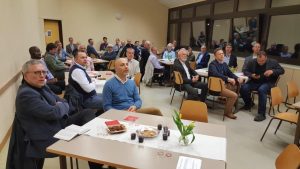 Spiritual times marked this theological meeting, with devotionals leaded by Marius Munteanu and Daniel Duda, the educational leaders of the two European divisions of the Adventist Church; a beautiful holy communion to begin the Sabbath; participation in the Sabbath worship of the Church of Collonges with the sermon of Luca Marulli, the president of the Association of European Theologians; or a very musical end of the Sabbath in the Chapel of the Maccabees, at the Cathedral of Geneva, a high place of the Reformation.
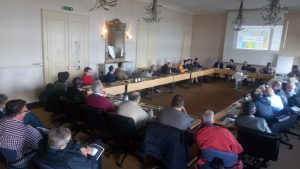 For Gabriel Monet, Dean of the Faculty of Theology of Collonges and coordinator of the conference: ‘These moments between Adventist theologians are precious, not